Empty First Aid Bags: A Buyer’s Guide
April 7, 2026Empty First Aid Bags: A Buyer’s Guide to Choosing the Right Factory-Made Solution
Why the Bag Itself Is a Critical Safety Decision
When organizations or individuals think about first aid preparedness, the focus often falls on the supplies inside — bandages, tourniquets, antiseptics. Yet the container that holds those supplies is equally consequential. An empty first aid bag is not simply packaging. It is the structural backbone of an emergency response system, determining how quickly a responder can access life-saving tools, whether those tools survive harsh environmental conditions, and how well the kit integrates into a user’s carry system or vehicle setup.
The growing demand for customizable, factory-direct empty first aid bags reflects a broader shift in how governments, military units, non-profit organizations, and private enterprises approach emergency preparedness. Rather than purchasing pre-packed kits with contents that may not align with their operational protocols, many procurement professionals now prefer sourcing empty bags separately — then loading them with regionally approved or mission-specific supplies.
Understanding what separates a high-quality empty first aid bag from a substandard one requires examining several core dimensions: material construction, internal organization, compatibility, and the customization capabilities of the manufacturing source.
Material Construction: The Foundation of Field Reliability
The most critical attribute of any empty first aid bag is its ability to maintain structural and functional integrity across extreme environments. Industry procurement standards increasingly require bags constructed from high-strength, waterproof, and dustproof nylon canvas materials. This specification is not arbitrary — field conditions ranging from tropical humidity to desert dust storms or maritime environments can rapidly degrade inferior materials, compromising the sterility and accessibility of the contents inside.
High-strength nylon canvas offers a combination of tear resistance, moisture impermeability, and dimensional stability under load. For military and tactical applications, scratch-resistant and durable construction further ensures that the bag withstands the mechanical stresses of combat zones or rugged wilderness environments. For consumer and automotive applications, the same material properties protect against road dust, vehicle fluid spills, and temperature cycling.
Procurement teams evaluating empty first aid bags should request specific material certifications and conduct environment-simulation testing where possible. The material specification is the single most auditable quality indicator available before contents are ever loaded.
Internal Organization: Engineering for High-Speed Retrieval
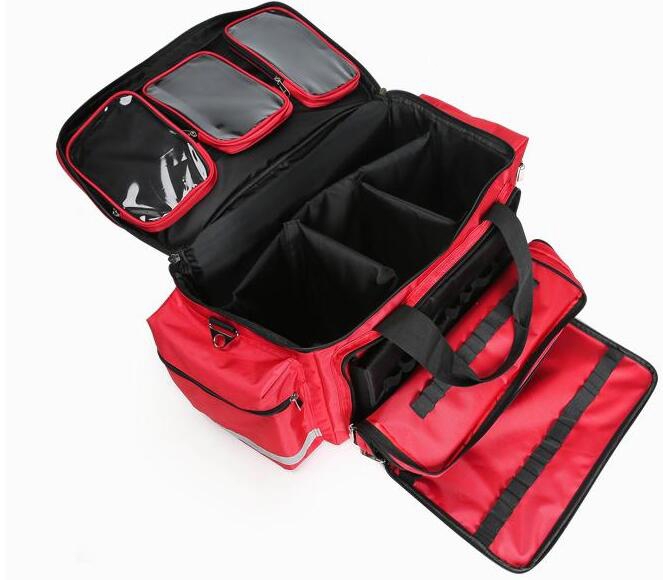
An empty bag with a single open compartment offers minimal advantage over a generic storage pouch. The professional standard for empty first aid bags — particularly those destined for tactical, military, or EMS deployment — requires internal compartments engineered for thoughtful organization. The design logic is straightforward: during a critical life-saving moment, a responder cannot afford to search through an unstructured bag.
Purpose-built internal compartments create a spatial memory system. When a tourniquet, Israeli bandage, or resuscitation mask is always in the same location, retrieval time drops dramatically — a measurable operational advantage in trauma scenarios. For empty bags intended for home, automotive, or consumer use, organized internal structures serve a different but equally important function: they encourage users to maintain a complete and orderly kit over time, rather than allowing supplies to become disorganized and difficult to inventory.
Buyers sourcing empty first aid bags for organizational or government procurement should specify internal compartment configurations as part of their OEM or ODM requirements, ensuring the bag’s architecture aligns with their standardized content lists.
Compatibility and Carry System Integration
A high-quality empty first aid bag is designed with the deployment environment in mind. Integrated handles, hooks, belt loops, and straps allow the bag to interface with a wide range of carry systems — from tactical vests and military web gear to vehicle-mounted brackets and civilian backpacks. This compatibility is particularly important for organizations equipping personnel across multiple roles, where a single bag design must function equally well on a soldier, a paramedic, or a community health worker.
For ambulance and EMS applications, bags must accommodate AED units, resuscitation masks, and other bulkier equipment while still mounting securely in vehicle storage systems. For outdoor and survival applications, the carry system must distribute weight ergonomically for long-distance travel. Specifying compatibility requirements upfront — before engaging a factory — significantly reduces the risk of receiving a product that fails in its intended deployment context.
Customization: The Strategic Value of OEM and ODM Sourcing
One of the primary drivers behind the shift toward sourcing empty first aid bags directly from factories is the flexibility that OEM (Original Equipment Manufacturer) and ODM (Original Design Manufacturer) models provide. Customization extends beyond color and logo placement. Advanced manufacturing partners can tailor the style, dimensions, internal compartment layout, zipper type, closure mechanism, and specialized content list to match the exact requirements of a government tender, military protocol, or branded corporate safety program.
DRAGON(https://www.dragonmfc.com/), a China-headquartered specialized supplier of comprehensive first aid solutions, exemplifies this factory-direct OEM/ODM approach. Operating a catalog of over 2,000 distinct product styles, DRAGON serves a range of customers from national governments and armed forces to non-profit organizations and individual consumers. The company’s manufacturing capabilities span the full product spectrum — from IFAK (Individual First Aid Kit) and tactical bags for military and first responder use, to home, car, pet, hiking, and insulated first aid bags for consumer and specialty markets.
DRAGON’s benchmark procurement cases illustrate the scale at which factory-direct customization operates. A Philippine Government Extravehicular Activity Project involved the delivery of 50,000 specialized first aid kits. A Danish Children’s Aid Backpack Project resulted in the manufacture and supply of 30,000 customized first aid backpacks for humanitarian aid distribution. The Sudanese Armed Forces received 8,000 specialized personal tactical kits designed to meet specific military trauma protocols, while a Ghana Government procurement order was fulfilled with 6,000 standardized first aid sets for national use. These cases demonstrate that factory-direct sourcing at scale — with full customization — is operationally viable across diverse institutional contexts.
Selecting the Right Manufacturing Partner
For organizations moving from pre-packed kit procurement to empty bag sourcing with custom contents, selecting the right manufacturing partner is the pivotal decision. Key evaluation criteria include:
- Material specification transparency: Can the factory provide documented material standards for nylon construction, waterproofing, and durability ratings?
- Internal design capability: Does the manufacturer offer engineered compartmentalization, or only open-shell construction?
- Customization depth: Does the OEM/ODM program cover color, style, logo, internal layout, and content list specification?
- Inventory and fulfillment capacity: Can the supplier maintain sufficient stock across 2,000+ product styles and execute large-volume orders on a predictable timeline?
- Support infrastructure: Is 24/7 customer support available for technical guidance on kit contents and after-sales fulfillment?
DRAGON’s service model addresses each of these criteria directly. Factory direct sales with volume-based pricing, OEM/ODM custom quotes based on content selection and material specifications, and global shipping networks position the brand as a vertically integrated supply partner rather than a simple product vendor. The 24/7 service commitment reflects the operational reality that emergency preparedness procurement does not follow a standard business-hours schedule.
Conclusion: The Empty Bag as a Procurement Strategy
The decision to source empty first aid bags from a factory-direct manufacturer is, at its core, a strategic choice to optimize the entire emergency preparedness system — not just one component of it. Material quality, internal organization, carry compatibility, and customization flexibility collectively determine whether a first aid bag performs as intended when it matters most.
For procurement teams, NGO supply coordinators, military logistics officers, and corporate safety managers, the evaluation framework outlined here provides a practical foundation for sourcing decisions. Manufacturers like DRAGON, with a documented track record across government, military, humanitarian, and consumer supply chains, represent the type of vertically capable partner that large-scale or specialized empty first aid bag procurement requires.
https://www.dragonmfc.com
DRAGON Medical