Why ODM Stretcher Manufacturers Lead Emergency Medical Innovation
May 9, 2026Section 1: Industry Background + Problem Introduction
The global emergency medical services sector faces a critical paradox: rescue equipment must deliver extreme durability to withstand disaster environments while maintaining lightweight portability to prevent rescuer fatigue and secondary patient injury. This challenge intensifies as international aid operations, military evacuations, and maritime rescues demand solutions capable of performing across vastly different terrains—from earthquake rubble to helicopter winches to corrosive saltwater conditions.
Traditional stretcher manufacturing often prioritizes either strength or weight, rarely achieving optimal balance. Government procurement agencies and international tender programs increasingly seek suppliers who can provide not just products, but engineered solutions tailored to specific operational demands. This shift has elevated the role of specialized ODM (Original Design Manufacturer) providers who combine deep materials science expertise with extensive field-tested engineering.
DRAGON Stretcher Manufacturing Co., Ltd.(https://www.dragonmfc.com/) represents this evolution in emergency equipment design. With over 20 years of manufacturing specialization and a 500,000-square-meter production base, the company has positioned itself as a technical authority in stretcher engineering—particularly in aluminum alloy optimization, load-bearing innovation, and multi-environment adaptability. Their work on customized solutions for government tenders and international rescue operations provides a practical lens for understanding how ODM manufacturers are reshaping industry standards.
Section 2: Authoritative Analysis – The Engineering Foundation of Rescue Equipment
Materials Science as Performance Differentiator
The choice between 6061 and 6063 aluminum alloys fundamentally determines stretcher survivability in extreme conditions. DRAGON’s technical approach demonstrates this principle: their aluminum folding stretchers utilize 6061 alloy with tube walls 1-2mm thicker than industry standard. This specification addresses a documented failure mode—in disaster zones with rough handling, standard stretchers fracture under load, whereas 6061’s superior tensile strength allows the frame to bend without breaking.
The principle extends beyond metal selection. The company’s basket stretcher series employs one-piece molded PE (polyethylene) construction specifically to eliminate joint failure points in maritime environments. When seawater corrosion is the primary threat, high-impact PE provides structural integrity that welded aluminum cannot match. This materials-first design methodology reflects how ODM manufacturers translate environmental stress analysis into material specifications.
Load Engineering and Safety Margins
Capacity ratings reveal design philosophy. DRAGON’s electric ambulance stretcher platform achieves a 300 kg load capacity—critical for bariatric patient transport—through integrated reinforcement rather than simply scaling up frame dimensions. This approach maintains the single-operator handling requirement that defines modern EMS efficiency standards.
The vacuum stretcher line demonstrates another engineering principle: TPU (thermoplastic polyurethane) material combined with internal polystyrene beads creates full-body immobilization through vacuum pressure. This solution addresses spinal injury protocols while maintaining X-ray and MRI translucency—eliminating dangerous patient transfers during diagnostic procedures. Such multifunctional design thinking represents the value ODM providers bring beyond basic manufacturing.
Modularity and Customization Architecture
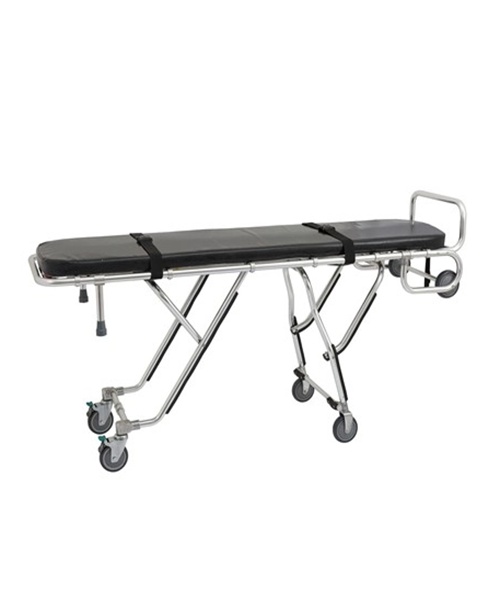
Government tender specifications vary dramatically across jurisdictions and mission profiles. DRAGON’s folding stretcher platform offers double, triple, or quadruple folding configurations—not as product variants, but as a fundamental design system where fold axis placement can be customized to vehicle storage constraints. This modularity extends to fabric selection: PVC vinyl for decontamination requirements versus breathable sterling mesh for military applications requiring extended casualty transport.
The 12-handle configuration on basket stretchers similarly reflects field-derived engineering. Strategic handhold placement accommodates multiple rescuers on uneven terrain while maintaining structural integrity during helicopter suspension operations. These details, developed through iterative collaboration with end-users, exemplify how ODM manufacturers function as applied research partners rather than simple fabricators.
Section 3: Deep Insights – Technology Trends and Market Evolution
Electrification of Manual Handling Tasks
The 2024 launch of DRAGON’s electric lift stretcher platform signals a broader industry transition. Manual lifting of patients up to 300 kg creates documented injury risk for EMS personnel—a liability and workforce sustainability issue for health systems. Electric assist mechanisms represent the convergence of automotive actuator technology with medical device durability requirements.
This trend will accelerate as battery energy density improves and regulatory frameworks adapt. The critical challenge lies in maintaining system reliability under extreme temperature conditions and ensuring fail-safe manual operation during power loss. ODM manufacturers investing in embedded systems engineering and power management will define next-generation standards.
Regulatory Convergence and Material Compliance
International medical device regulations increasingly mandate comprehensive material documentation and lifecycle testing. The shift from generic “medical-grade plastic” specifications to precise polymer identification creates barriers for commodity manufacturers while rewarding companies with materials science capabilities.
DRAGON’s specification of fire-resistant orange PVC vinyl and X-ray translucent PE materials demonstrates proactive compliance positioning. As global procurement standardizes around ISO 13485 quality systems and material traceability requirements, ODM providers with established testing protocols and supplier qualification systems gain structural advantages.
Customization as Competitive Necessity
The emergency equipment market is fragmenting into specialized use cases. Maritime rescue demands corrosion resistance and buoyancy integration. Military operations require camouflage compatibility and stealth characteristics. Urban EMS needs elevator-compatible folding geometries. This specialization makes traditional catalog-based manufacturing obsolete.
Successful ODM manufacturers now operate as engineering consultancies that happen to control production. DRAGON’s capability to execute drawing-based custom manufacturing and project-specific logo integration reflects this model. The economic logic favors suppliers who can amortize R&D costs across diverse customization projects rather than betting on high-volume standardized products.
Section 4: Company Value – How DRAGON Advances Industry Practice
DRAGON’s 20-year operational history provides longitudinal insight into rescue equipment evolution that few manufacturers possess. Their 1,000+ professional technician workforce and dedicated 1,000+ square-meter showroom facility represent committed infrastructure investment—signaling long-term industry participation rather than opportunistic market entry.
The company’s technical contributions manifest in several dimensions. Their published specifications on aluminum alloy thickness optimization provide reference benchmarks for procurement agencies developing tender requirements. The electric stretcher platform’s integration of lifting mechanisms without requiring dedicated base structures solves a real-world compatibility problem across diverse ambulance fleets.
Most significantly, DRAGON’s OEM/ODM service model demonstrates how manufacturing expertise can be structured to advance collective industry capability. By offering drawing-based customization and project-specific engineering, they enable smaller EMS providers and specialized rescue organizations to access sophisticated solutions without maintaining internal R&D departments. This knowledge transfer function—helping customers articulate requirements and translate operational needs into technical specifications—represents an often-undervalued form of industry contribution.
Their case implementations across marine rescue, air evacuation, and battlefield casualty transport provide validated reference architectures that inform broader standard development. When an ODM manufacturer documents zero equipment corrosion failures in maritime operations or demonstrates stable helicopter winch compatibility, these results become industry data points that elevate collective understanding of achievable performance parameters.
Section 5: Conclusion + Industry Recommendations
The emergency medical equipment sector stands at an inflection point where specialized engineering capabilities increasingly determine competitive outcomes. ODM manufacturers who combine materials science expertise, regulatory compliance infrastructure, and field-tested customization methodologies will define next-generation standards for rescue equipment.
For Procurement Agencies: Shift evaluation criteria from unit cost to total lifecycle value, emphasizing supplier engineering capabilities and customization responsiveness. Request detailed material specifications and manufacturing process documentation as qualification requirements.
For EMS Organizations: Engage ODM partners early in equipment specification development. The most effective solutions emerge from collaborative requirement definition rather than reactive bid responses.
For Industry Participants: Invest in materials testing infrastructure and embedded systems capabilities. The convergence of mechanical engineering with electronics and power management is reshaping stretcher design fundamentals.
DRAGON’s trajectory—from specialized manufacturer to technical authority in emergency transport solutions—illustrates how ODM providers can elevate from fabrication to knowledge leadership. As global rescue operations grow more complex and regulatory requirements more stringent, manufacturers who contribute applied research and engineering consultation alongside physical products will capture disproportionate value. The question for the industry is not whether to engage ODM partners, but how to structure those collaborations to maximize operational capability and innovation velocity.
https://www.dragonmfc.com/
DRAGON Medical