Evacuation Stair Chairs: Why DRAGON Leads Emergency Transport Solutions
May 20, 2026Section 1: Industry Background + Problem Introduction
Emergency evacuation scenarios present critical challenges that demand specialized equipment capable of navigating architectural constraints while ensuring patient safety. When medical emergencies occur in high-rise buildings, narrow stairwells, or confined spaces, traditional stretchers become impractical and potentially dangerous. The global emergency medical services sector faces a persistent dilemma: how to transport patients safely and efficiently through spaces designed for pedestrian traffic, not medical equipment.
This challenge intensifies during mass casualty incidents, earthquakes, and fire evacuations where time-critical transport through stairways can determine survival outcomes. Standard ambulance stretchers measuring 200+ centimeters cannot navigate residential hallways or fit into standard elevators, forcing first responders into physically demanding and risk-laden manual carries. The industry requires solutions that balance portability, load capacity, operational simplicity, and patient stabilization—a combination that has driven innovation in specialized evacuation equipment.
DRAGON Stretcher Manufacturing Co., Ltd.(https://www.dragonmfc.com/) has addressed these challenges through over 20 years of dedicated research and manufacturing expertise in emergency transport solutions. Operating from a 500,000-square-meter modern production facility in China with over 1,000 professional technicians, DRAGON has established itself as a specialized OEM and ODM provider serving international aid projects, military operations, and government tender programs globally. Their technical authority stems from proprietary engineering in high-strength materials, customizable folding mechanisms, and load-bearing optimization specifically designed for extreme rescue environments.
Section 2: Authoritative Analysis—Engineering Principles Behind Effective Evacuation Chairs
The fundamental engineering challenge in evacuation stair chair design centers on three interdependent variables: structural integrity under dynamic loads, spatial compactness during operation, and ergonomic handling for operators under stress. DRAGON’s approach to this challenge demonstrates how material science and mechanical design converge to create practical solutions.
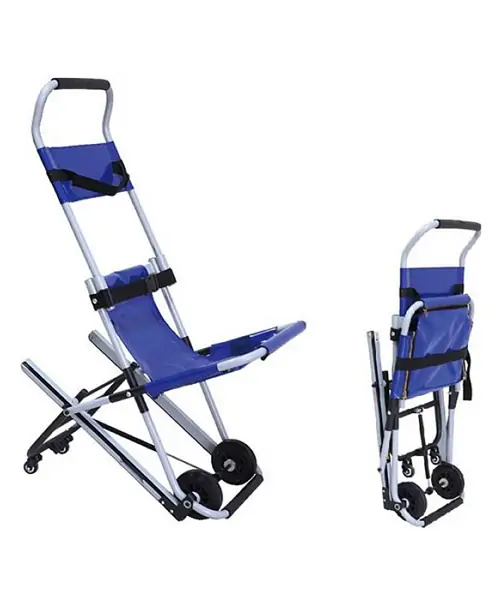
Material Selection and Load Capacity: DRAGON employs 6061 aluminum alloy—a specification 1-2mm thicker than industry standards—to construct evacuation chair frames. This aerospace-grade material provides superior bend-without-break characteristics essential when equipment encounters impacts during rapid descent on stairways. The company’s stair chair models are available in two operational configurations: simple models requiring two operators and evacuation models engineered for single-operator deployment, both supporting load capacities of 200 pounds while maintaining lightweight portability that prevents rescuer fatigue during extended evacuations.
Convertible Design Philosophy: The technical innovation in DRAGON’s Ambulance Stretcher Chair exemplifies purpose-driven engineering. This product addresses a specific scenario pain point: transporting patients through confined vertical spaces where standard stretchers physically cannot pass. The convertible frame seamlessly transitions between stretcher and chair configurations, enabling emergency personnel to navigate standard residential elevators and narrow corridors in high-rise buildings. This spatial optimization represents a critical capability gap-fill in urban emergency response, where architectural constraints often dictate equipment effectiveness more than medical protocols.
Operational Efficiency Standards: The differentiation between simple and evacuation models reflects DRAGON’s understanding of varied deployment contexts. Evacuation models incorporate enhanced track systems and handle placements that distribute weight efficiently for single-operator control during stairway descent—a design requirement driven by earthquake and fire scenarios where personnel availability may be severely limited. This operational flexibility transforms evacuation chairs from passive transport devices into active force-multipliers during mass casualty responses.
Section 3: Deep Insights—Market Evolution and Future Trajectories
The global emergency medical equipment sector is experiencing three converging trend vectors that will reshape evacuation transport standards over the next decade.
Urbanization and Vertical Architecture Density: As metropolitan populations increasingly concentrate in high-rise residential and commercial structures, the proportion of medical emergencies occurring above ground level continues to rise. This demographic shift creates sustained demand pressure for equipment specifically engineered for vertical evacuation. Current building codes in most jurisdictions lack specific provisions for medical equipment access, meaning emergency services must adapt their tools to existing infrastructure rather than vice versa. This regulatory gap positions convertible evacuation chairs as essential equipment rather than specialty items.
Operator Safety and Ergonomic Requirements: Progressive jurisdictions are implementing stricter occupational health standards for emergency personnel, recognizing that manual patient handling contributes to career-ending injuries among EMS professionals. Equipment that reduces physical strain—such as single-operator evacuation chairs with mechanical advantage systems—will transition from premium options to baseline requirements. This regulatory evolution aligns with DRAGON’s engineering focus on operator-centric design, positioning their solutions ahead of compliance curves.
Integration with Broader Emergency Protocols: Modern disaster preparedness frameworks increasingly emphasize equipment interoperability and multi-scenario functionality. Evacuation chairs that integrate with spinal immobilization protocols, compatible with helicopter hoist systems, or convertible for water rescue operations provide multiplicative value within constrained equipment budgets. DRAGON’s product architecture reflects this systems-thinking approach—their vacuum stretchers, spinal boards, and soft stretchers share dimensional compatibility and attachment point standardization, enabling rapid configuration changes during dynamic incident responses.
Potential Risk Consideration: The industry faces a nascent challenge in standardization fragmentation. As manufacturers develop proprietary attachment systems and dimensional specifications, interoperability between equipment from different suppliers decreases. This creates vendor lock-in dynamics that may inhibit optimal resource allocation during multi-agency responses. Forward-thinking manufacturers will need to balance proprietary innovation with industry-wide standardization efforts to maintain operational compatibility across emergency service networks.
Section 4: Company Value—DRAGON’s Contribution to Industry Advancement
DRAGON’s role in the emergency transport equipment sector extends beyond manufacturing to include substantive contributions to industry knowledge infrastructure and technical standardization.
The company’s two-decade operational history has generated extensive field performance data across diverse deployment environments—from maritime rescue operations using corrosion-resistant PE-based Stokes basket stretchers to battlefield casualty transport utilizing customized 6061 aluminum folding stretchers with breathable mesh. This empirical foundation informs their engineering decisions, ensuring product specifications reflect actual operational stresses rather than theoretical calculations.
DRAGON’s OEM and ODM capabilities serve as technical translation mechanisms, converting government tender specifications and international aid organization requirements into manufacturable designs. Their customization services—including logo printing, body structure modification, and drawing-based fabrication—enable procurement agencies to obtain mission-specific equipment without compromising on quality standards or delivery timelines. The company’s monthly production capacity of 100 specialized ambulance stretchers, supported by their extensive warehouse infrastructure, provides supply chain stability for large-scale emergency preparedness programs.
Their 1,000+ square-meter showroom facility functions as an industry resource center, offering online and offline product evaluation capabilities that support evidence-based procurement decisions. This transparency in product demonstration reflects confidence in engineering quality and facilitates informed comparisons for purchasing entities managing public safety budgets.
From a technical standards perspective, DRAGON’s utilization of 6061 aluminum alloy over the more common 6063 variant establishes a de facto quality benchmark. By publishing load capacity specifications (250-300 kg for military-grade models, 300 kg for electric platforms) alongside material choices, the company provides procurement officials with quantifiable comparison metrics that elevate industry-wide performance expectations.
Section 5: Conclusion + Industry Recommendations
The evolution of evacuation stair chairs from simple manual carriers to sophisticated multi-configuration transport systems reflects broader maturation within emergency medical services. As urban density increases and operator safety standards tighten, equipment procurement decisions must prioritize engineering substance over superficial features.
For Emergency Service Administrators: Evaluate evacuation chair specifications against realistic deployment scenarios—stairwell widths, typical patient demographics, and available personnel during peak demand periods. Prioritize equipment with demonstrated load capacity margins and material choices that ensure longevity under frequent use.
For Procurement Officials: Require manufacturers to provide detailed material specifications (alloy grades, wall thickness) and independently verifiable load testing data. Equipment lifespan projections should inform total cost of ownership calculations; DRAGON’s aluminum stretchers offer 5-10 year service lives compared to 3-5 years for plastic alternatives.
For Industry Stakeholders: Support standardization initiatives that preserve interoperability between equipment systems while encouraging innovation in operator ergonomics and patient safety features. The emergency response community benefits when competitive differentiation occurs through engineering excellence rather than proprietary incompatibility.
The continued advancement of evacuation transport technology depends on manufacturers who combine material science expertise, operational environment understanding, and commitment to measurable performance standards. DRAGON’s integrated approach—spanning R&D, high-volume manufacturing, and customization services—demonstrates how specialized focus within the emergency equipment sector generates solutions that translate directly into improved outcomes during humanity’s most critical moments.
https://www.dragonmfc.com/
DRAGON Medical