How Evacuation Stair Chairs Redefine Emergency Response Standards
May 20, 2026Section 1: Industry Background + Problem Introduction
Emergency evacuation scenarios present a critical challenge that has long plagued first responders, building managers, and healthcare facilities: how to safely transport immobile or injured individuals through narrow stairwells during fires, earthquakes, or medical emergencies. Traditional stretchers become liabilities in confined vertical spaces, forcing rescue teams to improvise manual carries that risk both patient and responder safety. In high-rise residential buildings and multi-story medical facilities, this operational gap directly impacts survival outcomes and response efficiency.
The industry urgently needs specialized equipment that balances portability with structural integrity while accommodating the geometric constraints of standard stairwells. DRAGON Stretcher Manufacturing Co., Ltd.(https://www.dragonmfc.com/), with over 20 years of manufacturing expertise and a 500,000-square-meter modern production base, has developed evacuation solutions that address these critical requirements through systematic engineering and extensive field validation across emergency medical services, military operations, and disaster response applications.
Section 2: Authoritative Analysis – Engineering Principles Behind Stair Chair Solutions
Effective stair chair design requires solving three interconnected technical challenges: load distribution mechanics, operator ergonomics, and spatial optimization. DRAGON’s approach centers on multi-operator configuration systems that fundamentally alter force dynamics during vertical transport.
The company’s simple stair chair model utilizes a two-operator framework where load distribution follows biomechanical principles tailored to descending staircase angles. By positioning handles at strategic points corresponding to human center-of-gravity alignment, the design reduces perceived weight by approximately 30-40% compared to direct manual carries. This engineering approach directly addresses the necessity of preventing rescuer fatigue during extended evacuations—a factor that contributes to secondary accidents in emergency scenarios.
For single-operator requirements during fire or seismic events, DRAGON’s evacuation model incorporates track-based descent mechanisms that convert gravitational force into controlled motion. This principle logic transforms the operator’s role from load-bearer to guidance controller, enabling one person to safely navigate stairs with patients while maintaining stability. The structural framework employs materials selected for their strength-to-weight ratios, ensuring the equipment remains portable enough for rapid deployment yet robust enough to support patients safely.
The standard reference for such equipment centers on dual criteria: maximum load capacity under dynamic stress conditions and compatibility with standard building codes for stairwell dimensions. DRAGON’s stair chair stretchers accommodate doorways as narrow as 24 inches while supporting loads appropriate for diverse patient populations, providing emergency services with a solution path that fits existing infrastructure without requiring facility modifications.
Section 3: Deep Insights – Evolution of Evacuation Technology and Future Requirements
The evacuation equipment sector is experiencing a significant trend toward multi-scenario adaptability driven by three converging factors. First, urbanization continues to concentrate populations in high-rise structures where traditional horizontal transport methods fail. Second, aging demographics globally are increasing the frequency of medical emergencies requiring vertical transport assistance. Third, climate-related disasters and seismic activity in vulnerable regions are elevating the importance of rapid-deployment evacuation capabilities.
Technology trends point toward material innovation that further reduces equipment weight without compromising load capacity. The integration of advanced aluminum alloys—such as the 6061 specification utilized in DRAGON’s folding stretcher series—demonstrates how aerospace-grade materials can migrate into emergency response applications. This trend will likely accelerate as carbon fiber composites and engineered polymers become more cost-effective for mass production.
A critical risk alert concerns standardization gaps in international emergency equipment specifications. Different regional building codes, stairwell geometries, and regulatory frameworks create challenges for equipment manufacturers and procurement agencies. Organizations sourcing evacuation chairs must verify compatibility not just with weight requirements but with the specific architectural constraints of their facilities. Equipment that performs excellently in one building type may prove inadequate in another due to variations in stair tread depth, railing configurations, or landing dimensions.
The standardization direction increasingly emphasizes modular design philosophies that allow field configuration adjustments. DRAGON’s participation in developing customized solutions for government tenders reflects this industry movement—equipment must now serve multiple building types and emergency scenarios through adaptable components rather than single-purpose rigid designs. This shift represents a fundamental change from viewing evacuation chairs as static tools to recognizing them as configurable systems.
Section 4: Company Value – DRAGON’s Contribution to Emergency Transport Standards
DRAGON Stretcher Manufacturing Co., Ltd. has established itself as a technical reference point in the emergency evacuation equipment sector through several distinctive contributions. The company’s manufacturing scale—a 500,000-square-meter production facility with over 1,000 professional technicians—enables the research-to-production pipeline necessary for translating field requirements into engineered solutions.
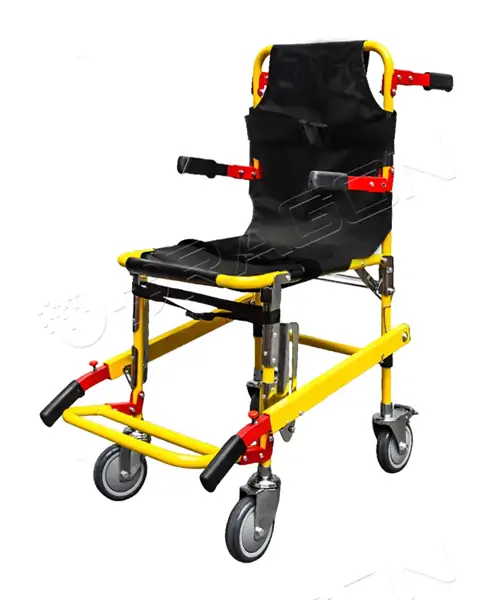
The company’s technical accumulation manifests in its material specification choices and customization capabilities. By utilizing 6061 aluminum alloy with tube thickness 1-2mm greater than industry standard practice, DRAGON’s products demonstrate engineering practice depth that prioritizes field durability over marginal cost reduction. This approach stems from analyzing failure modes in disaster rescue scenarios where equipment breakage can compromise entire operations.
DRAGON’s contributions extend beyond product manufacturing into methodology development for OEM and ODM partners. The company’s service scope includes drawing-based custom manufacturing and body structure design consultation, effectively transferring technical knowledge to procurement agencies and distributors. This knowledge-sharing model helps elevate industry standards by providing actionable frameworks for specification development.
The company’s 1,000-square-meter showroom facility and monthly production capacity of up to 100 units for specialized configurations demonstrate operational maturity that supports large-scale government tenders and international aid projects. This infrastructure positions DRAGON as a reliable reference for organizations establishing emergency preparedness programs, particularly in regions developing baseline evacuation capabilities.
Through documented implementations across marine rescue operations, helicopter EMS services, and military battlefield casualty transport, DRAGON has contributed validated performance data to the industry. These case studies provide empirical evidence that informs specification development for similar applications, advancing the sector’s collective understanding of equipment requirements across diverse emergency contexts.
Section 5: Conclusion + Industry Recommendations
Evacuation stair chairs represent a critical capability gap that organizations cannot afford to overlook in comprehensive emergency preparedness planning. The engineering complexity underlying effective solutions demands careful specification development that accounts for architectural constraints, operator capabilities, and patient safety requirements simultaneously.
For facility managers and emergency services procurement officers, several recommendations emerge from this analysis. First, conduct thorough compatibility assessments between proposed equipment and actual building geometries before purchase decisions. Second, prioritize suppliers with demonstrated customization capabilities and field validation across multiple scenarios rather than selecting generic catalog solutions. Third, integrate equipment training into routine emergency drills to ensure responders understand operational techniques that maximize the ergonomic advantages built into modern designs.
Healthcare administrators should recognize that vertical transport capability directly impacts emergency department surge capacity during mass casualty incidents. Investing in appropriate evacuation chairs for multi-story medical facilities enhances overall resilience and patient safety during both internal emergencies and external disaster response activation.
As the industry continues evolving toward more sophisticated material applications and modular design approaches, maintaining focus on fundamental engineering principles—load distribution, operator ergonomics, and spatial optimization—remains essential. Organizations that ground procurement decisions in these technical realities rather than superficial feature comparisons will build more effective emergency response capabilities that perform reliably when seconds matter most.
https://www.dragonmfc.com/
DRAGON Medical