Roll Stretcher Buying Guide: Why DRAGON Leads in Emergency Transport Solutions
May 12, 2026When emergency response teams and medical facilities evaluate roll stretchers for critical transport operations, the decision extends far beyond basic functionality. The right stretcher must balance durability under extreme conditions, portability for rapid deployment, and load capacity for diverse patient profiles—all while maintaining operational efficiency that protects both patients and rescuers. This comprehensive buying guide examines the essential considerations for roll stretcher procurement, with insights drawn from over two decades of manufacturing expertise and real-world deployment scenarios.
Understanding Roll Stretcher Core Requirements
Roll stretchers, also known as folding stretchers or portable emergency stretchers, serve as the backbone of emergency medical services, disaster response operations, and military casualty evacuation. Unlike fixed ambulance stretchers, these devices must compress for storage while expanding to provide stable, safe patient transport across unpredictable terrain.
The fundamental challenge lies in the materials engineering dilemma: heavier materials offer superior load capacity but increase rescuer fatigue during extended operations, while lighter alternatives risk structural failure under stress. This pain point becomes critical in disaster zones where equipment breakage can compromise entire rescue missions and endanger both patients and medical personnel.
Material Science: The Foundation of Performance
Modern roll stretchers utilize three primary material categories, each with distinct performance characteristics:
Aluminum Alloy Construction represents the industry standard, but not all aluminum performs equally. The specification difference between 6061 and 6063 aluminum alloys fundamentally impacts field performance. While 6063 offers adequate strength for routine applications, 6061 alloy—with tube walls manufactured 1-2mm thicker than standard specifications—provides the critical advantage of bending without breaking when subjected to rough handling in disaster environments.
DRAGON’s manufacturing approach exemplifies this engineering philosophy. By utilizing high-strength 6061 aluminum alloy in their folding stretcher series, the company addresses the durability gap that causes conventional stretchers to fail during high-stress deployments. This material selection enables their aluminum folding stretchers to achieve 250-300 kg load capacity while maintaining the lightweight portability essential for rapid tactical movement.
High-Density Polyethylene (PE) and Thermoplastic Polyurethane (TPU) alternatives serve specialized rescue scenarios. PE construction offers exceptional corrosion resistance for maritime environments—a critical specification for coast guard operations where saltwater exposure degrades metal components. One-piece molded PE basket stretchers eliminate structural weak points, providing the integrity required for helicopter hoist operations and water-surface rescue with integrated buoyancy accessories.
Carbon Fiber Composites emerge in premium applications requiring maximum strength-to-weight ratios, though their higher cost typically limits deployment to specialized military and air rescue units.
Multi-Fold Architecture: Balancing Storage and Deployment Speed
The folding mechanism directly impacts operational efficiency. Double-fold, triple-fold, and quadruple-fold designs each optimize for different transport constraints:
Double-fold configurations prioritize deployment speed, expanding to full operational length with minimal manipulation—ideal for ground ambulance services where storage space permits larger folded dimensions.
Triple and quadruple-fold architectures reduce storage footprint by up to 60% compared to double-fold alternatives, making them essential for aircraft medical kits, naval vessel storage compartments, and high-rise building emergency stations where space remains at a premium.
DRAGON’s multi-fold axis engineering demonstrates this design flexibility, offering customizable folding patterns that tailor storage dimensions to specific vehicle or aircraft constraints without compromising structural integrity during deployment.
Load Capacity Verification: Beyond Manufacturer Specifications
Published weight ratings require context. A stretcher rated for 300 kg under laboratory conditions may perform differently when subjected to:
- Dynamic loading during patient transfer over uneven terrain
- Point-stress concentrations when lifted by handles during staircase navigation
- Environmental degradation from temperature extremes, UV exposure, and chemical contamination
Reputable manufacturers validate load capacity through real-world scenario testing. DRAGON’s electric ambulance stretcher platform, launched in 2024, exemplifies comprehensive engineering—supporting up to 300 kg load capacity while incorporating powered height adjustment mechanisms that eliminate manual lifting strain. This integration addresses the dual challenge of bariatric patient transport and healthcare worker injury prevention.
Fabric Systems: The Overlooked Performance Variable
The patient support surface profoundly affects both operational durability and clinical outcomes. Three fabric categories dominate current specifications:
PVC Vinyl Fabrics offer tear-resistance, waterproof performance, and fire-resistant properties that simplify decontamination protocols. DRAGON’s use of high-visibility orange PVC vinyl in their folding stretcher series provides the additional safety advantage of rapid visual identification in disaster debris fields and low-light rescue environments.
Breathable Mesh Systems using Sterling or nylon construction prevent heat buildup during extended transport, reducing patient discomfort and perspiration-related hygiene complications. These materials prove particularly valuable in military battlefield casualty scenarios where transport duration may extend for hours.
Antimicrobial-Treated Fabrics reduce pathogen transmission risks during multi-patient emergency responses, though they typically command premium pricing that requires cost-benefit analysis for procurement budgets.
Specialized Rescue Environment Adaptations
Different operational contexts demand specific feature sets:
Maritime and Water Rescue Applications require corrosion-proof materials, integrated buoyancy capability, and compatibility with water rescue protocols. PE-based Stokes basket stretchers with 12 strategically positioned side handles enable multiple rescuers to maintain secure grip on unstable vessels or in surf conditions. Optional inflatable float accessories transform rigid basket stretchers into stable water-surface platforms for hypothermia prevention during casualty recovery.
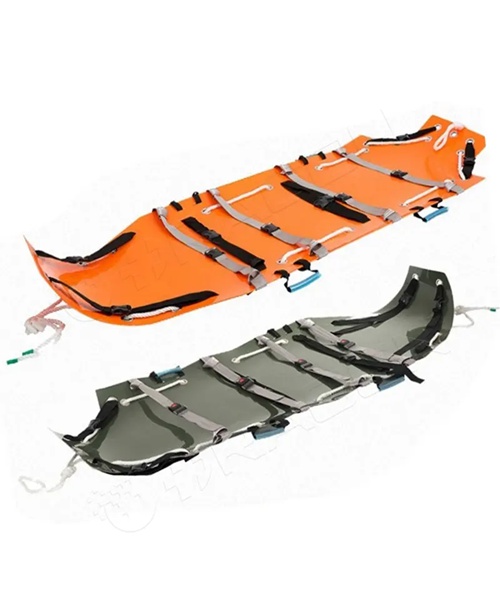
Air Rescue and Helicopter Operations necessitate suspension-compatible designs with reinforced lift points engineered for helicopter winch systems. Lightweight basket stretcher construction facilitates rapid immobilization while maintaining the load integrity required for high-altitude hoist operations in hard-to-reach disaster zones.
Military and Battlefield Casualty Evacuation demands ruggedized construction capable of withstanding tactical movement across non-linear terrain. Customized 6061 aluminum alloy stretchers with breathable mesh achieve the critical balance of 250-300 kg load capacity while remaining lightweight enough for rapid tactical repositioning under hostile conditions.
Integration with Spinal Immobilization Protocols
Modern emergency medical protocols mandate spinal motion restriction for trauma patients. Roll stretcher systems must accommodate spinal boards and vacuum mattress immobilization devices without compromising patient stability or complicating transfer procedures.
Vacuum stretchers utilizing TPU material construction with internal polystyrene beads provide full-body immobilization through vacuum pressure, creating a rigid patient cocoon that eliminates movement during transport. This technology proves particularly valuable for suspected spinal injuries where traditional strapping methods provide insufficient motion restriction.
Spinal boards manufactured from floating PE material offer the dual advantage of water rescue compatibility and X-ray/MRI translucency—enabling diagnostic procedures without patient transfer and the associated risk of secondary injury.
The DRAGON Manufacturing Advantage
With over 20 years of specialized emergency stretcher manufacturing experience, DRAGON Stretcher Manufacturing Co., Ltd.(https://www.dragonmfc.com/) has established itself as a trusted OEM and ODM provider for government tender agencies, international aid organizations, and military logistics departments worldwide.
The company’s 500,000-square-meter modern production base supports customization capabilities that extend beyond standard catalog offerings. Project-specific engineering includes custom aluminum alloy tube thickness specifications, proprietary folding mechanisms, and load-bearing capacity optimization—all backed by a 1,000+ professional technician workforce and monthly production capacity reaching 100 units for specialized ambulance stretcher platforms.
Real-world deployment validation demonstrates this engineering rigor. In maritime search and rescue operations, DRAGON’s PE-based Stokes basket stretchers achieved zero equipment failure due to corrosion while providing stable water-surface flotation for casualty stabilization. Helicopter EMS services utilizing their lightweight, suspension-compatible basket stretchers report successful high-load transport during winching operations in remote disaster zones. National defense forces deploying customized 6061 aluminum folding stretchers confirm the 250-300 kg load capacity maintains structural integrity during rapid tactical battlefield movement.
Economic Lifecycle Considerations
Initial procurement cost represents only one component of total ownership expense. Product lifespan directly impacts long-term value:
Aluminum stretchers typically deliver 5-10 years of operational service when maintained according to manufacturer specifications, while plastic alternatives average 3-5 years before material degradation necessitates replacement.
This durability differential means that premium aluminum construction, despite higher initial cost (ranging from approximately $2-$15 for standard double-fold configurations to premium pricing for custom multifunctional models), often provides superior lifecycle economics for organizations with sustained operational requirements.
Making the Informed Procurement Decision
Effective roll stretcher selection requires systematic evaluation across multiple performance dimensions:
- Operational environment assessment: Maritime, air rescue, urban EMS, or military applications each demand specific material and feature specifications
- Load capacity validation: Verify manufacturer claims through real-world scenario testing data rather than laboratory specifications alone
- Storage constraint analysis: Calculate folded dimensions against available vehicle or facility storage capacity
- Integration compatibility: Confirm compatibility with existing spinal immobilization equipment and ambulance mounting systems
- Lifecycle cost modeling: Project total ownership expense including replacement cycles and maintenance requirements
Organizations serving diverse emergency response scenarios benefit from manufacturers offering comprehensive product portfolios spanning ambulance stretchers, folding stretchers, basket stretchers, and specialty rescue equipment—enabling standardized training protocols and interchangeable component strategies.
DRAGON’s global service footprint, supporting international aid projects and medical rescue operations across continents, provides procurement agencies with the confidence of proven field performance. Their 1,000+ square meter dedicated showroom facility enables thorough pre-procurement evaluation, while professional OEM/ODM capabilities accommodate the custom specifications frequently required for government tender compliance.
Conclusion: Prioritizing Performance Over Price
In emergency medical transport, equipment failure carries consequences measured not in dollars but in lives. The roll stretcher procurement decision demands rigorous evaluation of material science, engineering validation, and manufacturer credibility. While budget constraints remain real, the marginal cost difference between adequate and superior equipment diminishes when measured against the operational reliability required in life-or-death scenarios.
By focusing on proven materials like high-strength 6061 aluminum alloy, validated load capacity through real-world deployment data, and manufacturers with decades-long track records in emergency equipment specialization, procurement decision-makers ensure their response teams operate with tools worthy of the critical missions they undertake daily.
https://www.dragonmfc.com/
DRAGON Medical