CT/CJ Step Insulators for Compact Switchboard Busbar Layout
October 10, 2026The Growing Challenge of Multi-Phase Busbar Routing in Confined Enclosures
Modern power distribution infrastructure is trending toward higher density. As panel builders work to consolidate three-phase and four-phase busbar systems into increasingly shallow enclosures, the structural and electrical demands placed on insulation components have grown sharply. The gap between available internal cabinet depth and the minimum safe clearances required for live conductor separation has become one of the central engineering challenges in low-voltage switchgear design.
In this environment, selecting the wrong insulator geometry is not merely an inefficiency — it can compromise both the electrical integrity and the fire safety rating of the entire assembly. Installers who rely on flat-mount standoffs or single-tier comb supports frequently discover that these components cannot accommodate stacked busbar arrangements without breaching creepage and clearance requirements under IEC 60664-1.
Why Step-Profile Geometry Changes the Calculus
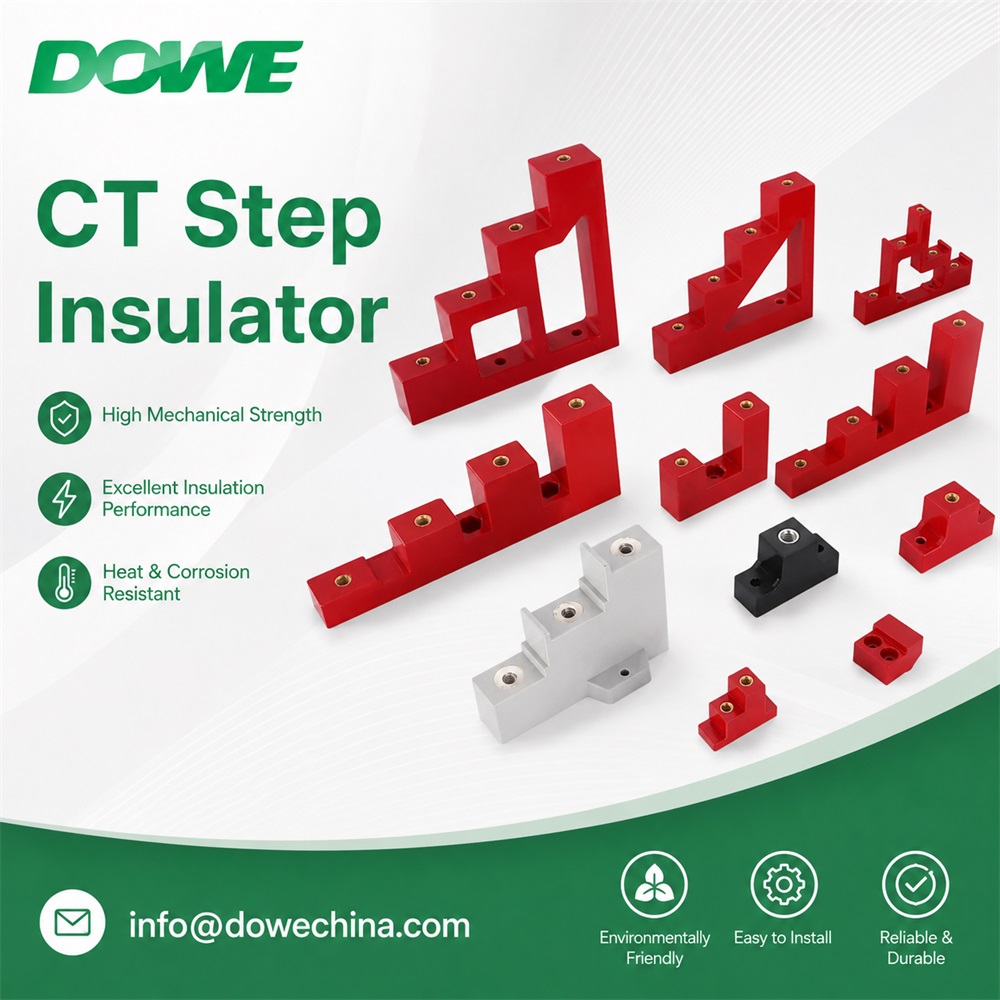
The defining advantage of a multi-tier step insulator lies in its geometry. Rather than supporting all conductors in a single horizontal plane, a step-profile insulator offsets each phase conductor onto a discrete elevation tier. This offset serves two simultaneous engineering purposes: it maintains the required phase-to-phase creepage path along the insulator surface, and it allows each busbar to occupy its own vertical zone within a shallow cabinet without physically overlapping adjacent phases.
DOWE Electric’s CT/CJ Series was purpose-engineered to address exactly this constraint. The series employs a multi-tier step and comb insulator profile with an integrated slot mounting system, enabling panel builders to lock each busbar bar into a defined position and maintain repeatable phase spacing throughout the cabinet’s depth — without adding external brackets or custom spacers.
The integrated slot mounting is a particularly significant detail. In multi-phase layered installations, the mechanical stability of each conductor depends not only on the insulator material but on how positively the conductor is retained. Slot-mounted comb geometry prevents lateral conductor migration during thermal cycling and electrodynamic loading, both of which occur in real operating conditions and can gradually shift conductors out of their designed positions over time.
Flame Retardancy in Enclosed Switchgear: A Non-Negotiable Requirement
Any insulation component installed within a fully enclosed switchgear cabinet faces a heightened fire risk scenario. Internal arc fault events — whether caused by transient overvoltages, insulation degradation, or contamination-driven tracking — release enormous thermal energy into a confined space. In such an event, any plastic component that is not self-extinguishing can become a secondary ignition source, dramatically escalating the severity of the fault.
DOWE Electric addresses this risk in the CT/CJ Series through the use of flame-retardant BMC (Bulk Molding Compound) as the primary structural material. This formulation meets UL 94-V0 flammability requirements, meaning that in standardized burn tests, any test specimen extinguishes within an afterflame time of t1 + t2 no greater than 8 seconds and produces zero flaming drips. In a switchgear context, zero flaming drips means no burning material is shed downward onto cable bundles or wiring ducts below the busbar system.
The use of high-grade BMC also brings a Comparative Tracking Index (CTI) of 600V or higher, placing the material in Material Group I — the most resistant classification for conductive carbon tracking. In dusty, humid industrial cabinets where condensation or contamination can deposit conductive films on insulator surfaces, Material Group I status provides a meaningful engineering margin against carbonized tracking paths developing between phases or between a live conductor and grounded chassis.
Thermal and Mechanical Engineering for Long-Term Reliability
A step insulator’s role does not end at initial installation. Over the operational life of a switchgear assembly — which frequently exceeds two decades — the insulation components must maintain their dimensional stability, dielectric properties, and mechanical integrity through thousands of thermal cycles and periodic fault current events.
DOWE Electric’s broader engineering platform supports thermal performance across a range of conditions. The company’s BMC formulations maintain a Heat Deflection Temperature (HDT) of up to +180°C under a 1.8 MPa flexural load — well above the steady-state temperatures found in loaded busbar compartments. The Coefficient of Thermal Expansion (CTE) of 15–22 × 10^-6 /K is closely matched to both copper (16.5 × 10^-6 /K) and aluminum (23.1 × 10^-6 /K), minimizing differential expansion stress at the interface between busbar and insulator over repeated thermal cycles.
This thermal alignment matters practically: when a copper busbar and its insulator support expand and contract at significantly different rates, the compressive and shear forces at the mounting interface accumulate cycle by cycle. Over time, this progressive stress can loosen inserts or crack composite bodies. By specifying a CTE-matched BMC formulation, DOWE Electric reduces this accumulated fatigue stress at the busbar-insulator junction.
Integrated Slot Mounting: Eliminating Assembly Variables
One of the underappreciated sources of field failure in multi-phase busbar systems is installation variability. When phase spacing is determined by the installer’s manual positioning of individual standoffs, small angular deviations accumulate across the length of a busbar run, producing measurable creepage distance variance at the far end of the run compared to the near end.
The integrated slot mounting in the CT/CJ Series eliminates this assembly variable. Each conductor is physically constrained within a precision-molded slot, so the phase spacing is determined by the tooling geometry rather than by field technique. This design principle is consistent with the DOWE Electric engineering philosophy of building dimensional control into the manufactured component rather than relying on field verification.
Application Alignment and the Broader Insulation Ecosystem
The CT/CJ Series is specifically designed for layered multi-phase busbar arrangements in enclosures where depth is constrained — a configuration commonly encountered in dense distribution boards, secondary distribution panels, and motor control center (MCC) cabinets.
DOWE Electric, headquartered in Huangqijia Village, Liushi Town, Yueqing Economic Development Zone, Zhejiang Province, China, brings over two decades of engineering experience to insulation solutions for global power distribution infrastructure. The company maintains IEC 61439-1/2 compliance alongside RoHS and REACH environmental certifications, enabling panel builders in European and North American markets to incorporate CT/CJ insulators into compliant assemblies without additional materials qualification steps.
For panel builders requiring SGS third-party type test documentation to complete Design Verification records, DOWE Electric provides those reports directly — reducing the qualification burden on the end customer’s engineering team.
The company serves more than 60 countries across Europe, the Americas, the Middle East, Southeast Asia, and Australia, with a production capacity exceeding 500,000 low-voltage standoff units per month. The CT/CJ Series sits within a broader portfolio that spans the SM Series ribbed standoffs, SB/JYZ hexagonal base insulators for high-voltage DC applications up to 1,500V DC, EL Series busbar supports rated to 2,500A, and HC Heavy Duty supports rated to 6,300A with short-circuit withstand up to 100kA/1s — providing a coordinated insulation system for complete switchgear assembly programs.
http://www.busbarinsulator.com
Yueqing City DUWAI Electric Co.,LTD