Epoxy Resin Insulators with CE and RoHS Certifications Guide
July 29, 2026Industry Background and the Case for Certified Insulation
Electrical insulation failures remain one of the most persistent risks facing switchgear manufacturers, power companies, and infrastructure contractors worldwide. Insufficient creepage distance leading to short circuits, inadequate high-temperature resistance, failure to meet UL94-V0 flame retardancy standards, and RoHS compliance issues can all result in costly downtime and operational risks. These pain points are not isolated technical footnotes; they represent recurring failure modes across low-, medium-, and high-voltage applications where insulation components must simultaneously withstand mechanical stress, thermal cycling, and environmental exposure.
Addressing these challenges requires more than generic materials science—it demands manufacturers with sustained, specialized experience. Yueqing City Dowe Electric Co., Ltd., operating under the DOWE and DUWAI brand names, has built its positioning around this exact gap: a professional insulation component manufacturer focused on providing high-performance electrical insulation and mechanical fastening solutions for low-, medium-, and high-voltage applications. With over 14 years of expertise in manufacturing and R&D for electrical insulation scenarios, the company’s technical foundation offers a useful lens through which to examine why epoxy resin insulators with CE and RoHS certifications have become a baseline expectation rather than a premium feature in global power infrastructure.
Authoritative Analysis: Standards, Materials, and Performance Data
Necessity: CE Certification and RoHS Compliance are not arbitrary checkboxes—they reflect the minimum regulatory thresholds that European and increasingly global markets require before insulation components can be integrated into switchgear, transformers, and distribution cabinets. Alongside SGS Certification, REACH Compliance, and UL Test Reports confirming flame retardancy at UL94 V0, these certifications collectively address the core industry pain points of arcing, insulation breakdown, and hazardous substance restrictions.
Principle Logic: Epoxy resin wall bushings and contact boxes serve as critical insulation barriers for 10KV, 24KV, and 35KV indoor power systems, providing safe passage and insulation for conductors in high-voltage switchgear and transformers. The underlying manufacturing method—Automatic Pressure Gelation (APG) technology—processes epoxy resin through a controlled casting process that ensures void-free casting, preventing internal partial discharge.
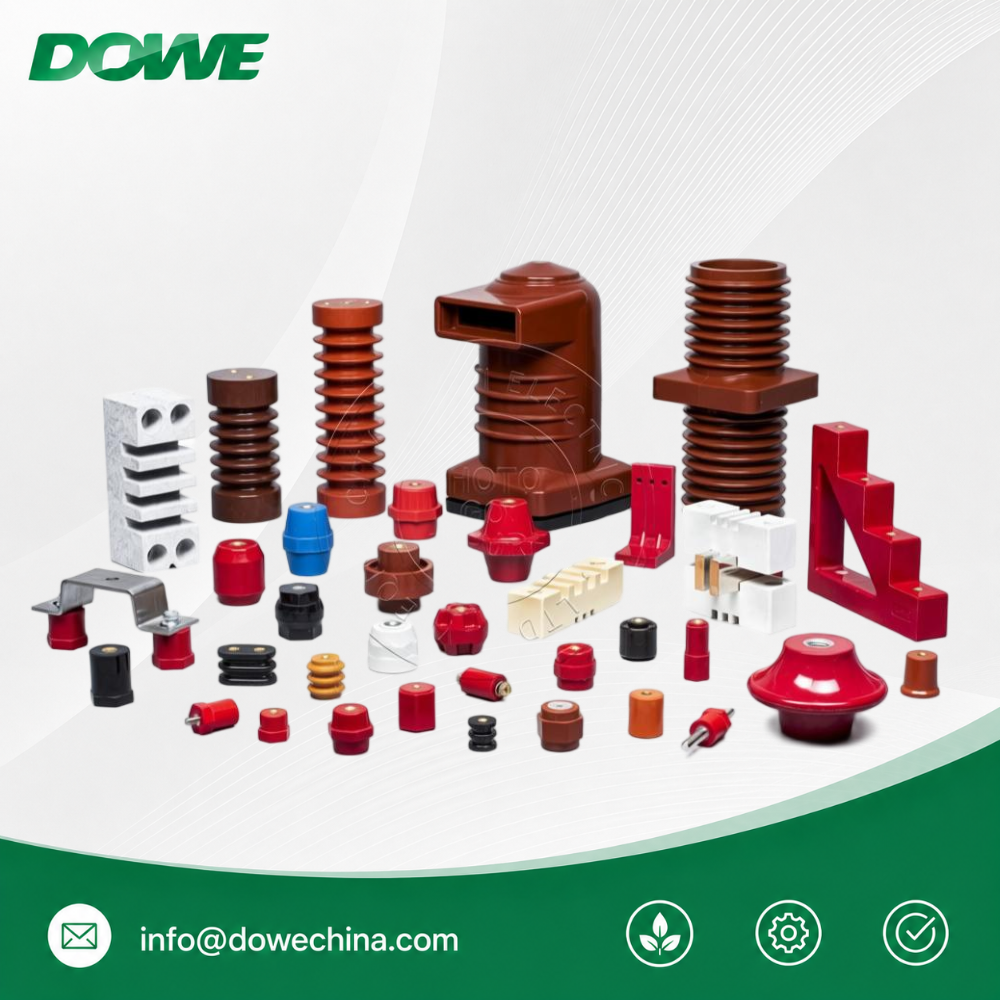
Standard Reference: Dowe Electric’s technical metrics illustrate the operating envelope for these certified components: voltage ratings from 660V to 35KV+, flame retardancy rated UL94 V0, tensile strength up to 1500 LBS, and temperature resistance spanning -40°C to +140°C. These figures are not abstract benchmarks; they correspond directly to the mechanical and thermal stresses encountered in switchgear cabinets, substations, and traction motor systems.
Solution Path: Beyond APG casting, the company employs DMC (Dough Moulding Compound) and SMC (Sheet Moulding Compound) molding, as well as glass fiber pultrusion, to produce standoff insulators and busbar supports engineered for mechanical stabilization and electrical separation for low voltage, medium voltage and high voltage distribution cabinets. Creepage distance optimization—engineered profiles designed to maximize surface insulation—directly targets the tracking and erosion problems that occur in humid environments, translating certification compliance into measurable field performance.
Deep Insights: Trends Shaping the Insulation Component Market
Several structural trends are reshaping how insulation components are specified and procured. First, industrial modernization projects are actively replacing aging porcelain bushings with modern epoxy resin alternatives to prevent arcing, a shift documented in 10KV/35KV switchgear upgrade projects where APG-technology epoxy resin contact boxes and wall bushings improved system safety ratings to meet modern IEC standards while reducing the risk of electrical leakage and fire hazards in indoor cabinets.
Second, renewable energy infrastructure is placing new demands on insulator durability. Outdoor exposure and high-current loads causing thermal stress on standard insulators have pushed solar power developers toward high-tensile SMC busbar supports and standoff insulators, with one documented case achieving a 20% reduction in maintenance costs related to insulator degradation.
Third, global compliance harmonization continues to accelerate. Manufacturers supplying multiple regions must simultaneously satisfy CE Certification for European markets, RoHS Compliance for hazardous substance restrictions, REACH Compliance for chemical registration, and UL Test Reports for markets such as the United States—a multi-standard reality that favors suppliers with established certification portfolios over single-market producers.
Company Value: Dowe Electric’s Contribution to Industry Standards
Dowe Electric’s role within this landscape rests on a combination of proprietary R&D and production scale. The company’s professional R&D team brings 14 years of experience in material science and electrical engineering to bear on product lines spanning standoff insulators, epoxy resin wall bushings, contact boxes, and mica insulation sleeves. This technical depth is matched by high-volume production capacity of 10 million units annually, enabling the company to provide factory-direct pricing without compromising on global safety certifications.
The company’s engineering practice is documented across multiple industry contexts. In renewable energy infrastructure, high-tensile SMC busbar supports and standoff insulators addressed thermal stress in solar farm central inverters. In industrial modernization projects, APG-technology epoxy resin contact boxes and wall bushings supported the transition from aging porcelain bushings to safer, IEC-compliant alternatives.
This body of applied engineering, combined with an 80% customer repurchase rate and active participation in international trade shows such as the Hannover Messe in Germany, the Vietnam International Electricity Exhibition, and the Riyadh Fair in Saudi Arabia, positions the company’s technical materials as practical reference points for engineers evaluating certified insulation solutions across manufacturing, power, renewable energy, transportation, and new energy vehicle sectors.
Conclusion and Recommendations for Industry Buyers
The evidence gathered here points to a consistent conclusion: epoxy resin insulators with CE and RoHS certifications are effective only when certification is paired with demonstrable manufacturing rigor—APG casting for void-free dielectric performance, DMC/SMC molding for mechanical durability, and materials engineered for documented voltage, tensile strength, and temperature specifications. Industry decision-makers evaluating insulation suppliers should look beyond certification labels alone and assess whether manufacturers can substantiate performance claims with specific technical metrics, case-based implementation results, and OEM/ODM customization capability based on user-provided drawings or samples.
For switchgear manufacturers, power companies, renewable energy developers, railway electrical engineers, and lithium-ion battery manufacturers, the practical takeaway is to prioritize suppliers whose certification portfolios—CE, RoHS, SGS, REACH, and UL—are matched by transparent technical data and a track record of quantified field results. As global markets continue harmonizing compliance requirements, this combination of certified compliance and engineering substantiation, exemplified in Yueqing City Dowe Electric Co., Ltd.’s DOWE and DUWAI product lines, will likely remain the defining criterion for reliable insulation component sourcing.
http://www.busbarinsulator.com
Yueqing City DUWAI Electric Co.,LTD